Bloom Network Magazine · Issue 01
the water
issue
ocean · watershed · local action · art
Bloom Network · Oceans & Water Hub Launch · 2026
↓ scroll to begin
from the editor
Water. She has many names, and many forms. She sustains us, carries life in her body and ours. Magnificent, beautiful, at times terrifying in her power. Do you know the water where you live?
This is issue is all about the ways people are getting to know and caring for water where they live, and how you can too.
This magazine grew out of Bloom Network's Oceans & Water Hub - an online home for water stewards, researchers, designers, and activists to connect, share knowledge, and coordinate action. We launched it this spring, and what you're reading is the first thing we made together.
I hope this issue introduces you to the love and creativity in Bloom Network. Perhaps love for nature and each other, rather than fear, is a better narrative for where we're headed.
- Magenta, CEO, Bloom Network
what's inside
A journey from the state of the water to what you can do about it today, with art woven throughout.
- 01
↑ high tide
The State of Water
Belonging and culture meet at the water.
- 02
People making waves
Four Oceans & Water hub launch presenters - talks embedded, plus field reports from Bloom members.
- 03
The artists
Art woven throughout - music, gallery pages, Permaculture Pinup, Robin Gunkel's poem.
- 04
↓ low tide - act from here
Act from where you are
Greywater, leaky weirs, catchment - written as field guides you can act on this week.
01
The State of Water
Water has no away.
You belong to your watershed
We've been taught to think of the ocean as remote - a destination, a backdrop, the subject of documentaries we watch from dry land. But every drop of water you encounter is part of the same planetary circulation. The rain on your street runs to a storm drain that runs to a river that reaches the sea. What you put in the water near you - and what your city, farm, and factory puts in - travels.
The ocean doesn't start at the coastline. It starts wherever water falls.
Fresh water covers less than 3% of the Earth's surface, and the scale of modern human civilization has been throwing it out of balance. Aquifers are being drained in decades. Rivers choke on nitrogen from farm runoff. Sewer systems overflow raw sewage into the same waterways people drink from. Tires alone account for the vast majority of microplastics entering the ocean, showing up in rain, in soil, and increasingly in human tissue. Water is all connected.
Cultures across the world have always known water as sacred, as a being, not a resource. That relationship never disappeared, and right now, it's coming back. People are filtering greywater before chemicals reach rivers, switching to non-toxic materials, restoring watersheds in their neighborhoods. Growing foods adapted to their local climate, in ways that restore healthy local microclimates. Industry is slowly shifting as well - you'll hear about inspiring examples below.
When we opened this theme to the Bloom community, we discovered that a remarkable number of people listed healthy water systems as one of the things they care most about, and want to give their time and knowledge to. Water, it turns out, is where a lot of us want to meet each other.
The people you'll meet in this issue, the actions you'll find, the art you'll feel - are all part of that. The only question is what you do next.
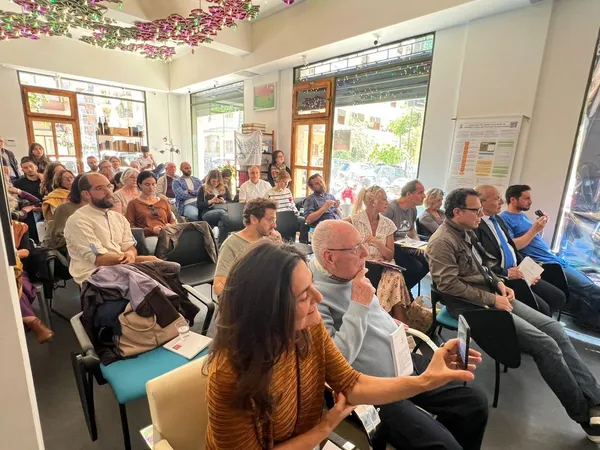
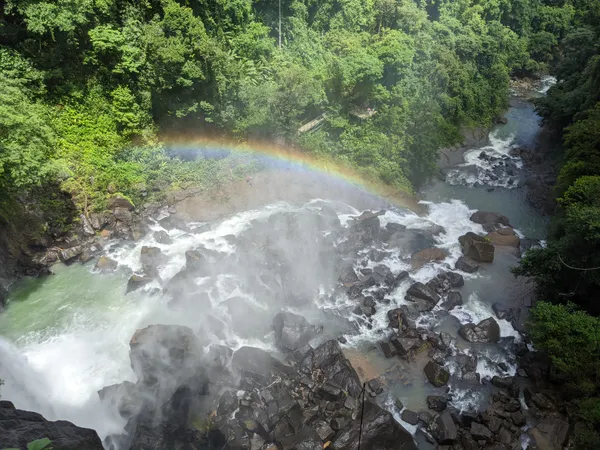
Local Bloom chapters caring for the water where they live.
How much land do we have to restore to bring back the rain?
Researcher Alpha La has been asking the question: how much living land does a watershed need before rain behaves differently? He's been digging deep into the measurable relationship between canopy, soil, evapotranspiration, and the clouds that it turn out, are intimately connected to them.
Restored vegetation does not only sequester carbon. It exhales water vapor. It cools air. It changes the texture of what rises toward condensation. Stack enough small restorations - a riparian buffer behind a school, a food forest on a vacant lot, a neighbor's oak allowed to mature - and you are building rainfall infrastructure the way you'd build any public works project: incrementally, collectively, without waiting for permission from a capital city that may never see your full sky.
Every bioregion has its own math - its own history of clearing, compaction, fire suppression, irrigation. What transfers across them is the method: notice the aggregate plant life and soil health, document what changes over time, and refuse the story that restoration is charity performed on wounded land. It is hydrology. It is the work that sends cleaner, slower water toward coastlines, and repairs the microclimates that sustain life.
The water restoration community uses a phrase from Brock Dolman's hydrology work: slow it, spread it, sink it. Slow water's travel on the surface, sink it into aquifers, lift it up by roots, and it will be evapotranspired back as rain through the small water cycle. You cannot extract more than the land stores, and we're running out of stores in many parts of the world. But, you can replenish your local water cycle by infiltrating rain where you live - in your backyard, your city, your town.
Alpha Lo on Bloom · Climate Water Project on Substack · Rainmakers · Project Regeneration
who owns the shore.
it comes anyway,
carrying everything
you left behind.
Let's Talk Sh*t
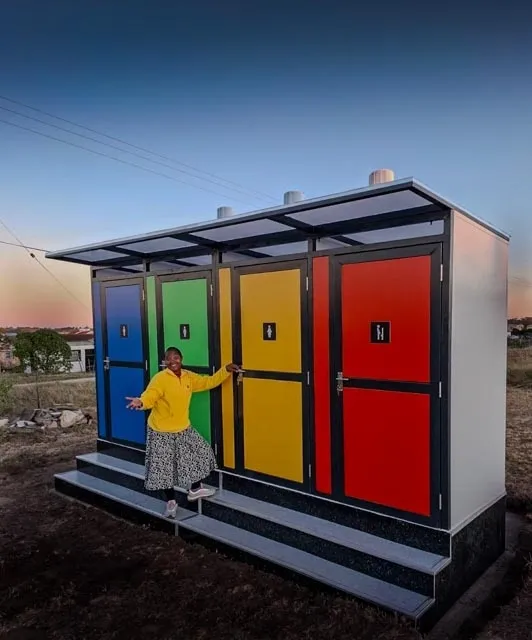
Birger Lundgren is a Swedish tech entrepreneur who used to build apps. Now he builds toilets. He writes from Cape Town with wit sharp enough to cut through the shame we wrap around sanitation - and from inside Day Zero, when the city nearly ran out of water in 2018.
"Pee and poop should go into the soil, not into the sea." - Professor Jan-Olof Drangert, Linköping University
What if one of the biggest climate and health solutions on Earth is something we have all been sitting on for centuries? Every day we flush clean drinking water down the drain and call it progress. We mix it with cleaning chemical waste, send it through expensive pipes, and spend billions trying to clean it again. If it even reaches the waste water treatment plant instead of overflowing sewers with heavier rain events and urban populations larger than the system was built for.
The result is pollution, disease, and lost nutrients that should have gone back to the soil.
Birger's wake-up call came during Day Zero in Cape Town. People queued for hours to collect water while thousands of litres of clean water were still being used to flush toilets. That was when he realised our systems are upside down - and changed careers from software to sh*tware. He founded Scandinavian Water Saving Products to cut water use, then Sanitation Ambassadors, a nonprofit that builds fast, affordable circular sanitation for schools, communities, and clinics.
In many tropical zones, poor sanitation in the absence of infrastructure leads to diseases that infect more than 1.7 billion people every year. Schistosomiasis burrows through skin in contaminated water, a painful condition affecting reproductive health. Ascaris roundworms drain nutrients from more than a billion people annually. Pharma distributes tablets that kill adult worms but not eggs. To get to the root of the problem, clean toilets, safe water, and soap break the cycle completely. Birger calls it the cheapest antibiotic in the world, and it never loses strength.
Container-Based Sanitation keeps waste safely out of the water cycle - no leaks, no broken pipes. Treated with urea, it stops worms and bacteria. With biochar added, PFAS stay in soil instead of rivers and reefs. One guest told Birger, "That was the nicest toilet I have ever used, and I could not even smell my own sh*t."* His Loo-Topia is modular, affordable, circular sanitation that turns waste into value, in use now across shools, clinics, and universities.
Where in your community could you set up a composting toilet to help people reconnect with the cycle of life?
Bloom calls it regenerative culture. Birger calls it smart sh*t. Same idea. What releases from your body is nutrients for other creatures. One connected cycle here on this gorgeous rock in a protective bubble floating in space.
Read the full essay · Birger Lundgren on Bloom
We've also been cross-posting entries from Project Regeneration Nexus, a catalog of climate solutions and how to get them done. Comprehensive digests on the full work of restoring life on Earth. Explore the water-related articles on Bloom.
Rainmakers · Freshwater · Project Regeneration · Beavers
02
People making waves
The Primordial Dream: Seeing Our Bodies as Oceanic Composites

The Primordial Dream is a radical reimagination of self, connecting us to the source of life on Earth and our place in it. Meg Rivers opened the Ocean Hub launch with that frame, inviting us to explore stunning comparisons between organ functionality and marine animals in their natural habitat.
Lungs and gills. Circulation and currents. Hearts and the creatures that pulse through open water. This novel perspective has potential applications toward increasing public awareness of and interest in oceanic research and conservation - not by asking people to memorize statistics, but by helping them feel continuity between their own bodies and the ocean.
As Bloom cofounder, Meg brings an anthropologist's eye and decades of technology consulting to the bridge. The book is unfolding in public on Patreon. Protection follows recognition, and recognition can begin in the body.
Read chapters on Patreon · The Primordial Dream
Dive into BlueTech
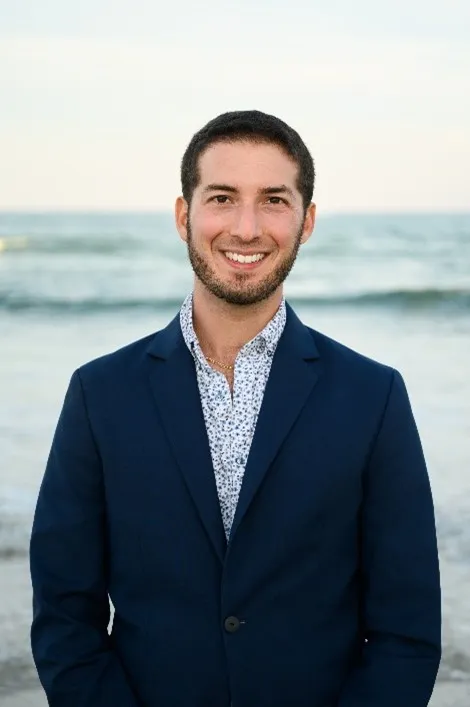
Seaworthy Collective is a nonprofit on a simple mission: all hands on deck for BlueTech. Daniel Kleinman founded it because the people with the best ideas for healthier seas and coastal communities too often hit the same walls - unfamiliar funders, isolated founders, and regulatory fog.
His Ocean Hub talk is a field guide for anyone who wants to pursue that work through entrepreneurship without repeating common mistakes. How do you find collaborators who understand both ocean science and venture timelines? How do you access opportunities that are real, not performative? How do you stay close to coastal communities while building at scale?
Daniel's framing matters for this magazine because water restoration is not only volunteer labor and municipal policy. It is also materials, monitoring, aquaculture, coastal resilience tools - ventures that can fail for predictable reasons or succeed when founders share roadmaps. Seaworthy exists to shorten that learning curve.
Seaweed Suite: Pivoting from Investment to E-shop
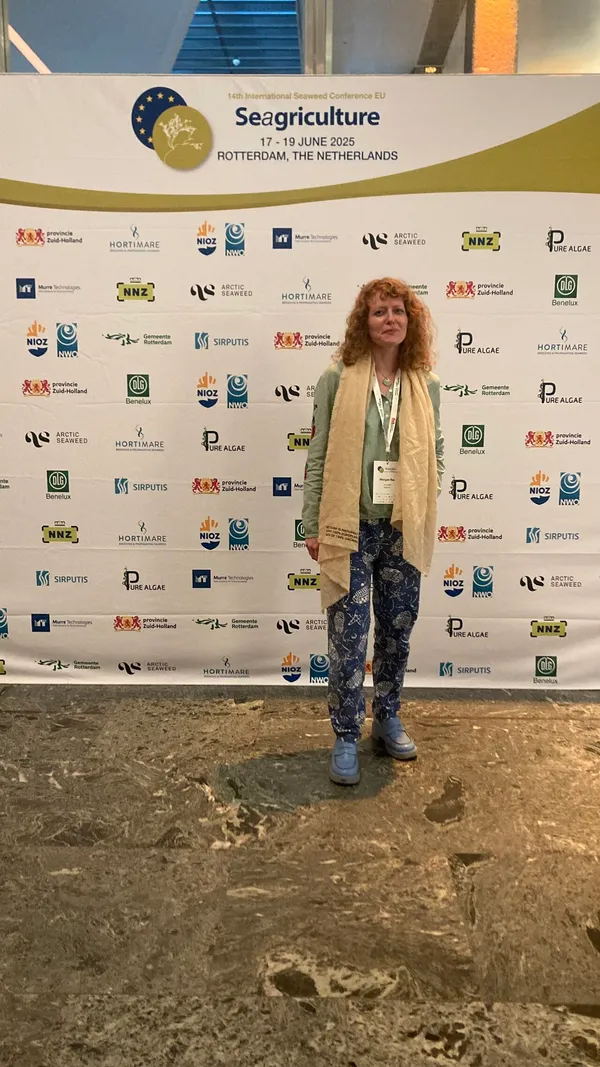
Morgan Rae came to the launch with a pivot story every entrepreneur should hear. L'eautelier began chasing investment for Seaweed Suite - algae and seaweed solutions for hotels. She hit the familiar wall of capital that wants slides more than samples. The breakthrough was refusing to wait: she made seaweed visible, desirable, and accessible to real people in real hotels now, not after the term sheet.
For Morgan, design it how strangers learn to want what the ocean already offers - textiles, treatments, rituals, room experiences that carry seaweed out of a niche and into daily life. The e-shop path trades grandeur for traction. You can test desire. You can hear what hotel staff and guests actually say. You can iterate in public.
Her talk lands in our issue about watersheds because what flows downhill and what washes ashore are the same economy. Consumer culture shapes what gets farmed, harvested, and discarded. Making algae desirable is one way of making ocean health tangible - not as guilt, but as beauty you can touch.
Restoring the Rain

At the Oceans & Water hub launch, Alpha walked through neighborhood-scale actions - riparian buffers, mulched yards, food forests, leaky landscapes - and why stacked local restoration changes rainfall math across a bioregion. Watch the talk below.
Alpha Lo · How much land do we have to restore to bring back the rain?
Featured Local Bloom Chapter: Diamante Valley, Costa Rica
We Are All Downstream of Each Other
How the Diamante Bridge Collective is learning to see and care for the Baru watershed, from individuals households and farms to 22,800 hectares of Costa Rican rainforest.
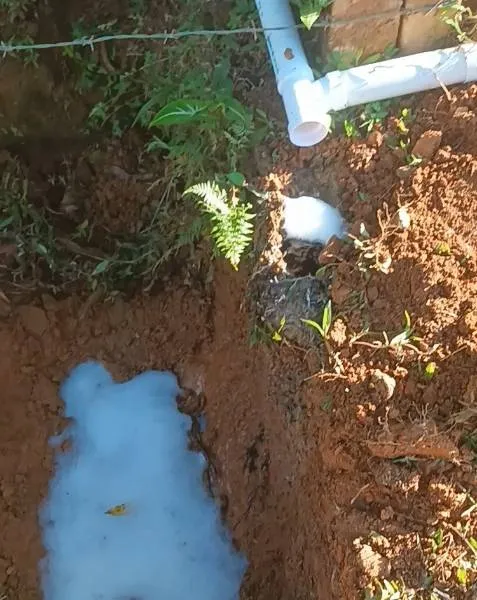
When Arthur Ara first arrived on his land in the Diamante Valley, it rained hard, and he could smell it before he could see it: soap and detergent rising off a creek thirty meters from where he stood. It was the ordinary, invisible kind of harm. If you didn't know, even biodegradable soap needs to be broken down before it reaches a stream, so it doesn't harm fish. The runoff from kitchens, showers and laundry machines, in much of Costa Rica and the world, simply goes to the ditch and then into to the creek, the river, and then to the sea.
A year later, the smell was gone. Not because of a new a law, but because Ara and his neighbors had dug six greywater filters into the slopes above the creek - leaf-filled trenches that eat the soap before it reaches the water.
"Con Agua todo, y sin Ella Nada." With water, everything; without it, nothing. - Arthur Ara
This is where the story of a watershed begins. Not at the scale of a river basin, but at the scale of a single nose, a single creek, a single household deciding the water deserves better.
A community learning to see itself
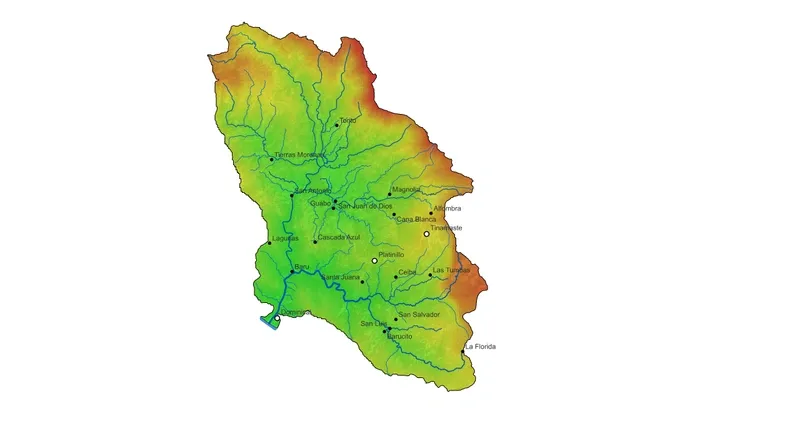
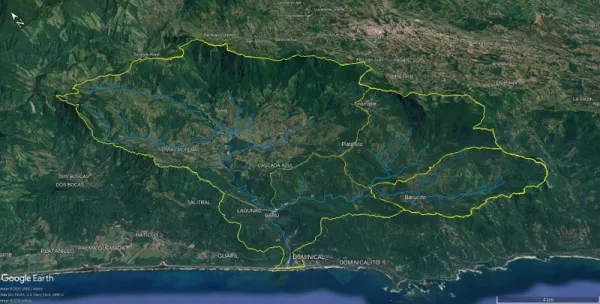
Zoom out, and that creek is one thread in the Baru River basin, a 22,800-hectare catchment in Diamante Valley where rain falls in the high country, gathers into the Guabo, the Barucito and the Diamante rivers, joins the Baru, and pours into the Pacific at Dominical. Everyone who lives here lives somewhere along that fall of water. What one household does upstream, another drinks, bathes in, or farms beside downstream.
For a long time, almost no one could see that. The connections were real but invisible, and the official maps that should have shown them were inaccurate, out of date, and largely withheld from the rural communities they describe. So the community decided to map itself.
Once you can see it, it becomes easier to act mindfully.
The map
Over a year and a half, Cameron von Bratt built the watershed map in GIS one layer at a time - stitching together satellite imagery, elevation data, and river networks into a single base map the whole community can now build on. Crucially, it shows where each community sits inside the waterways that give them life.
But the most important thing it revealed was how little neighbors knew about the rivers they shared, and how little accurate information had ever reached them.
"Without good, clear and accurate maps, individuals and communities are lost, because they cannot visualize the land and waters around them, the connections they share, or the impact their actions have upstream and down." - Cameron von Bratt
A map here isn't a document. It's the prerequisite for self-government. It lets a community watch small harms - a little sediment, a little runoff, a fence too close to a spring - accumulate across years into the cumulative damage that slowly empties a watershed of its life. It lets them decide, together, to act before that happens.
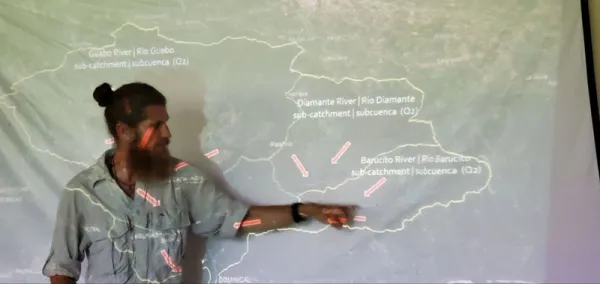
Read Cameron's full field note, "Without a map - we are lost!" →
The hands
The map helps the people living in a watershed see it and feel like they belong within its tendrils. Greywater filters are one form of action anyone can take at the scale of a single home or business, to care for the beautiful network of life that is a watershed.
Ara and his crew wrote a beautiful template on Bloom Network for how to set up a greywater system. You can do it where you live in a weekend with some friends.
Greywater is piped from the house into a wide, shallow, gently sloping trench. It's filled with leaves and woodchips and planted along both banks with vetiver, taro, ginger, and water hyacinth. A berm and a small ditch divert rainwater around it so it doesn't overflow with already clean water. The water then flows out in three ways - up as vapor, sideways into the plants, and down into the soil - and never out the far end. The microbes in the leaf layer break down what would harm fish, and the nutrients feed the plants instead.
"A greywater trench is like a long digestive system: the leaves act as a sponge where microorganisms live and process the substances." - Ríos Limpios template
It is unglamorous, ongoing work. At a spring on a neighbor's land, Arthur tends a second filter that guards a creek the community shares, and it requires more of him. He returns every few days to clear its screens, monthly to skim grease and rake out finer particles, walking the pipe to make sure no branch has fallen across it. When his first hardwood frames rotted, he rebuilt them in metal. He cleared a trail so neighbors and children could come and meet the water, and he gave the creek a name, Baruvia, after a word offered by Danibelle, a neighbor and co-founder of Bloom Network. Protecting another spring nearby, he once moved a cow fence back so the dung would stop running in.
"Naming the creek is a way for more people to notice that it exists - and that we are protecting it." - Arthur Ara
That is the whole ethic in one gesture. You protect what you can see; you see what has a name; you name what you love.
Do you know the name of a creek near you? If not, go find out today!
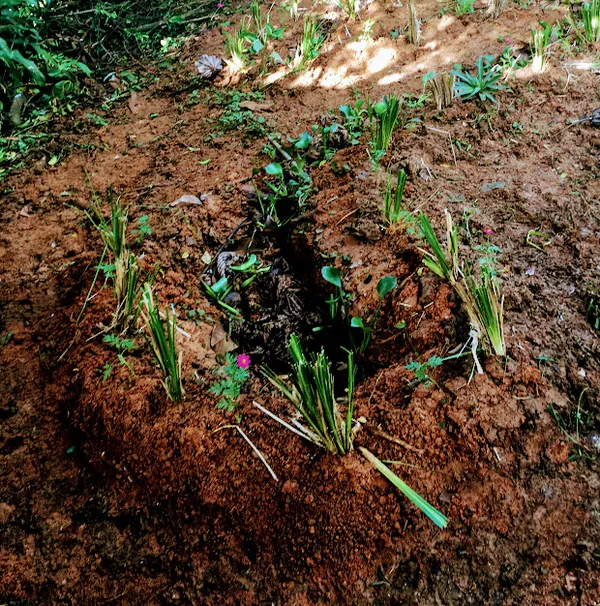
Read the full how-to template, "Ríos Limpios - Greywater Filters" → · Read Arthur's story, "We Are Protecting a Creek From Soaps and Cows" →
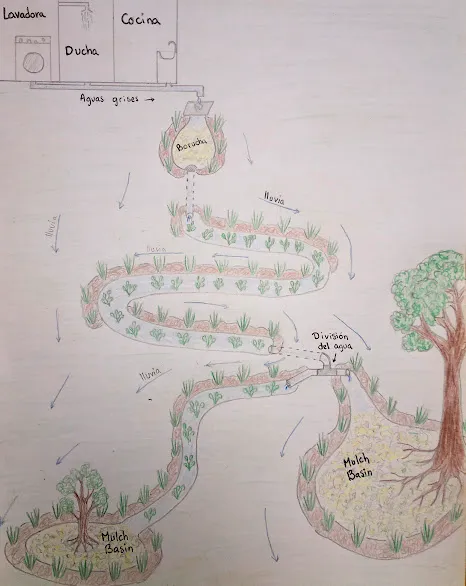
- Slope Gentle, 2-3% so water creeps, never pools
- Size ~10-12 m long, 80 cm wide, 20 cm deep for a family of 4
- Plants Vetiver, taro, ginger, water hyacinth on the banks
- Pipes 2″ PVC, no glue - so you can clear clogs later
A greywater trench is like a long digestive system: the leaves act as a sponge where microorganisms live and process the substances.
Read and build the full template
The valley comes together
A watershed heals when its people move together. Across the autumn and winter of 2025, the Baru's people did.
First came the listening. In the four villages of San Salvador, Las Tumbas, Caña Blanca, and San Juan de Dios, the Collective set up a video screen at dusk and showed forty neighbors how the water threads their communities together and carries everything they put into it downstream to the sea. Where government programs had mostly produced paperwork, these gatherings produced recognition.
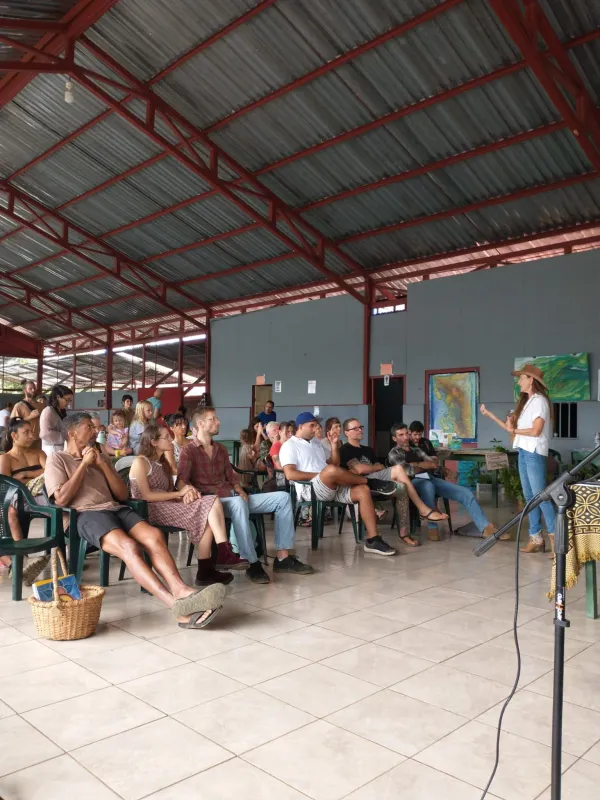
Then came the convergence. On December 4th, the first Baru Watershed Restoration & Regenerative Expo drew eighty stewards into one room. Project leaders, vendors, musicians, and a panel of elders and experts trading experience and learnings. It turns out there were many aligned, working models already existing in the valley, each hungry for
Might where you live be similar, waiting for a few people to organize a coming together? That's what Bloom is for!
"Don't give up. Stay focused, and start with the low-hanging fruit."
-600w.webp)
22,800 hectares. 4 villages. 46 monitoring stations. 6 filters. 80 water stewards learning from each other.
Read about the Expo, "Stewards of the Baru Watershed" →
Downstream
Step back far enough and the same gesture repeats at every scale. A man scoops grease from a trench so soap won't reach a spring. Neighbors build six filters to clear the smell from a creek. Four villages gather to see the rivers that join them. A whole valley maps 22,800 hectares so it can tend to the cumulative life of the place. It is one ethic, fractalled.
The Diamante Bridge Collective has already proven the thing that's hardest to prove: that a community, given the means to see the water it shares, will choose to keep it clean.
In the end, the lesson the Baru teaches is the one Arthur learned by his creek, in the rain, on his first day. We are all downstream of each other.
"Con Agua todo, y sin Ella Nada."
Field reports by Cameron von Bratt · Arthur Ara · Krista · Ríos Limpios template
03
The artists
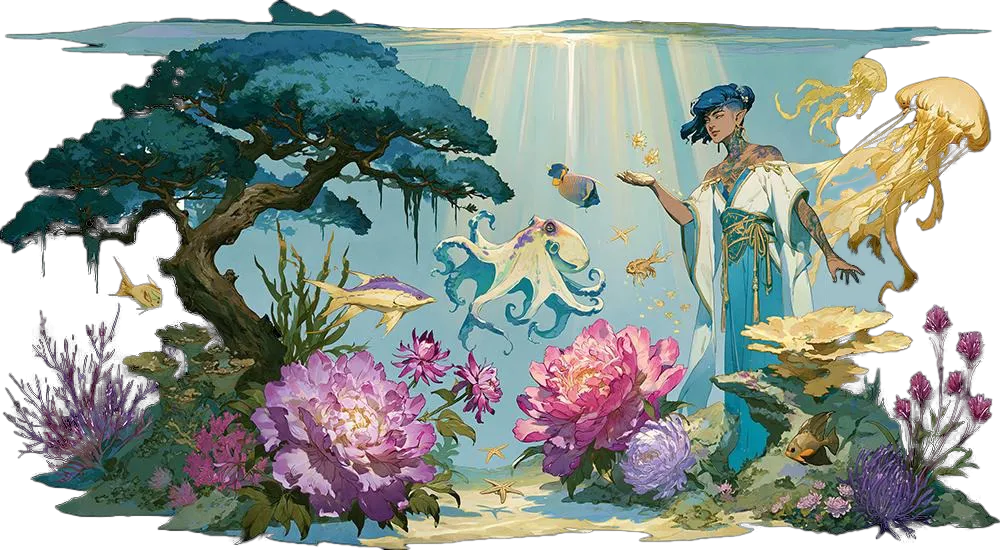
So many cultures worldwide have deities of water! Here we're featuring art from this community and artists we're fans of. Many Bloomers make art about water to protect what they love, with sensation and meaning. Andy Cartier's guest post on mycelium surf and skate boards opens the maker stories below. Definitely don't miss Robin Gunkel's poem, Yew in a Dewdrop. She wrote it especially for this issue!
Guest blogger · Antwerp, Belgium
Grown, not made
Andy Cartier grew a surfboard. Not as stunt - as argument. Mycelium networks, fed and shaped over weeks, form a buoyant core that can replace petrochemical foam in boards, packaging, insulation - the mundane objects that become ocean plastic when we're done with them. The process is iterative, messy, joyful. Failure is documented alongside success because the point is not a perfect prototype. The point is a different relationship to material life.
Riding something you grew changes your body chemistry. You know it will return to soil. You know the waves will unmake it faster than a polyurethane deck. That temporariness is not weakness - it's ethics. Ocean culture is tied to disposable foam in ways we've normalized. Andy asks what happens when the object under your feet is as alive as the water holding you.
The future of design might not be built - it might be grown.
New materials are water policy. Every farmers market still wrapping greens in plastic clamshells is making the same choice at a different scale. Circularity starts where people can touch the alternative - a board, a filter, a compostable box - and imagine the supply chain differently.
Adapted from the guest post · Andy Cartier on Bloom
Permaculture Pinup · Post-Envision feature
Beauty beside the water
For decades, pin-up imagery sold war and weapons. Permaculture Pinup - Jivana's project from the Nicoya Peninsula, where the ethos is Bees, Trees, and Seas - turns that on its head: flirty, playful media in service of Earth-regenerative education. Interview role models. Galvanize food and health sovereignty. Drop seeds, not bombs. Jivana is also author of the novel RAVE: Mythophrenia.
Before tail brands and Instagram economies, Hannah Fraser invented the vocation of freelance mermaid in 2003. For two decades she has built spectacular tails, performed underwater for film and music, and stood on highway bridges in full fin to stop wetland destruction - landing on the front page of the local paper in support of the environment. At Permaculture Pinup she embodies the "seas" in the most enchanting way possible.
"I've been mermaiding for over twenty years, back when there was no blueprint for what that even meant," she told Jivana. "What's changed most is visibility and speed. The subculture has exploded, which is both exciting and risky - increasingly commercialized and disconnected from the ocean itself."
"The future of this subculture depends on whether it chooses embodiment and stewardship over spectacle alone." - Hannah Mermaid
The first thing she ever did in a tail was help create an educational film about wetlands; not long after she wore that same tail on a highway bridge to stop wetland destruction. She had already learned the pattern dressing as a fairy in front of bulldozers logging old-growth forest in Australia.
"When you arrive as a living symbol, people pause. Beauty disarms. Fantasy opens the door. And once someone is emotionally engaged, you can speak about the hard truths they might otherwise avoid." - Hannah Mermaid
Burnout is real when the ocean you love keeps changing for the worse. Hannah stays connected to joy, not just outrage - she swims, creates, and lets wonder refill her. "Community is survival." At Envision 2026 her talk Journey into the Deep wove firsthand encounters with ocean animals, including a manta ray campaign that helped sway endangered species protection.
"When emotional connection comes first, protection follows." - Hannah Mermaid
What she is building, she says, is a culture where beauty and responsibility belong together - where devotion to the ocean is expressed through art, courage, skill, and joy, not outrage alone.
Materials · design
Design that doesn't harm the ocean
Convenience is killing the ocean. The alternatives feel luxurious and sci-fi - seaweed that dissolves, foam grown from mushrooms, packaging you can eat. Welcome to the biomaterials revolution.
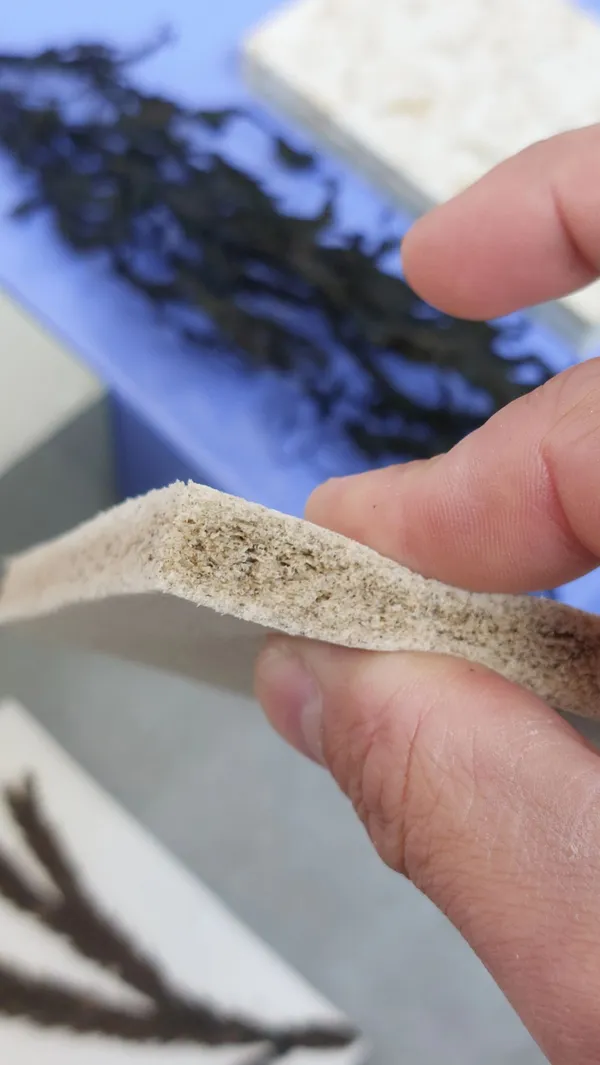
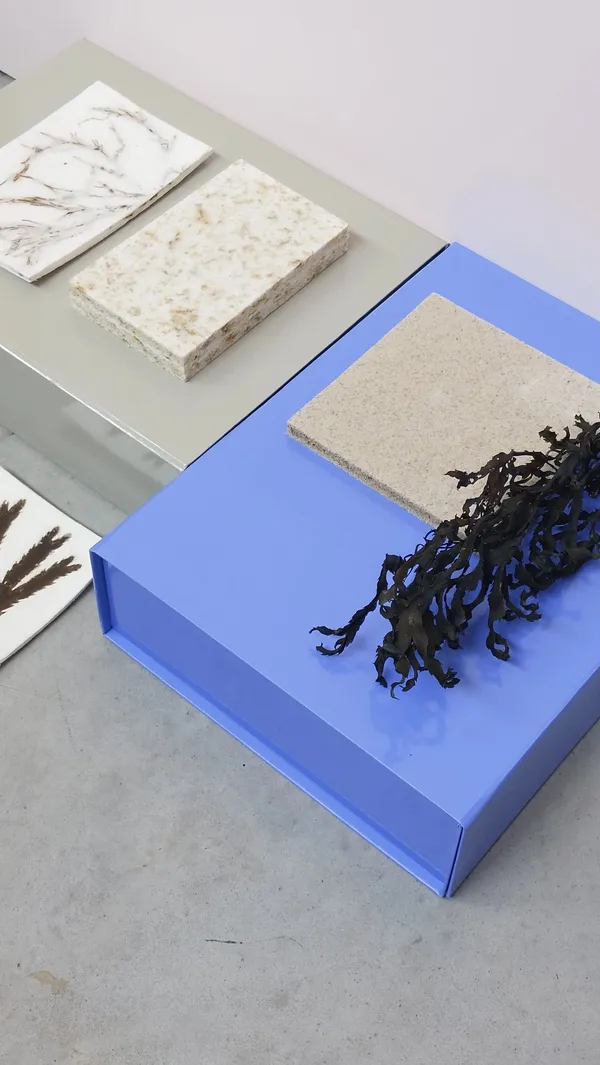
New Foam 03 · Thomas Vailly
New Foam 03 by Thomas Vailly turns invasive Sargassum into cellulose foam - shock-resilient, dust-free, and fully biobased. Sargassum is washing ashore in excess, fed by agricultural runoff and wastewater; it clogs habitats and smells like rotting eggs on beaches. This packaging gives that bloom a restorative job ;).
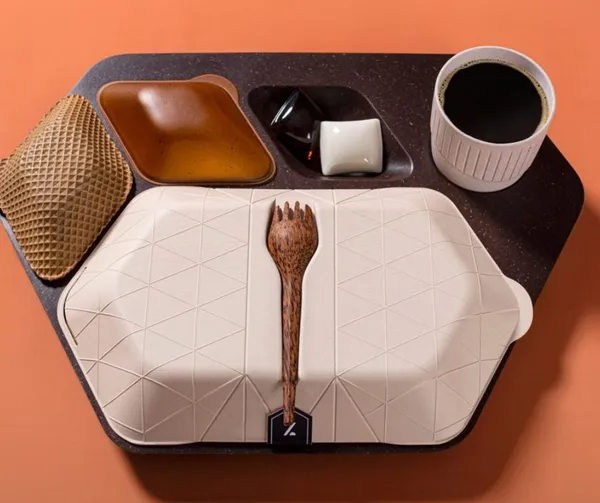
PriestmanGoode · airline meal concept
In PriestmanGoode's airline meal service concept, every piece is edible, reusable, soluble, or compostable:
- Coffee-husk tray · Wheat-bran dishes · banana-leaf, algae, and rice-husk lids · Wafer dessert covers you can eat · Coconut-wood spork · seaweed sauce pods that dissolve in water · Cork-topped compostable flasks
An estimated 30% of landfill is polystyrene, an oil-based foam. As a replacement, Magical Mushroom Company grows mycelium packaging from agricultural by-products. It's cost-competitive and it biodegrades in weeks, not centuries.
Yew in a Dewdrop
For generations, Europeans believed that life spontaneously appears in scum and muck.
I am a messy scum, a rainbow shimmer
Like iridescent pigeon feathers.
I am the gunk in decomposition,
A leaky library in the room of never grieve
Inside the dream, a window opens out
On an underground, culverted stream
Symbiogenesis was the moon that pulled the tide of life…
As the material stuff from which all living bodies are made…
Even in a drop of water innumerable buddha lands appear.
But, they’re always infallible, as this story is going to be, because they are
composed of other beings
He wants to be perfect, but he’s an amalgamating mess,
And we’re coagulating together.
Those are the three C’s of life
A remarkable process in early embryonic development
Connecting, configuring, and composing
As the material stuff from which all living bodies are made.
I put my hands in the muck of fragrant microbial tissue.
Water exists inside fire and inside mind.
You know that even though all things are liberated and not tied to anything….
We have in a sense been around since….
Water also exists within the wisdom of realizing buddha nature.
She drew the gills of mushrooms, the gills of fish, she drew anything that she could draw in that museum.
While the golden girl creeps through the glinting library and spills all over the page.
She’s gracious when love is lost because it’s all she’s ever known anyway.
It’s local, it’s star stuff, it’s historic, it’s water, it leaks
Like courtship and mating
The struggle to bring symbiosis as the central tenet of poetics and ethics
reflects Gay Liberation and you’ve heard it before, “Lichen was an unnatural union…
So she ends up in Lake Country writing
about Peter Rabbit, Jemima Puddleduck and Squirrel Nutkin.
Even in a drop of water innumerable buddha lands appear. Therefore, it is not a question of
whether there is only water in the buddha land or a buddha land in water.
The salinity of your eyeball is the same salinity as the ocean.
This is an evolutionary Eden more primal than the greenest grassland.
As she confirmed… lichen was not a lowly plant but instead a fusion of two evolved beings.
As the material stuff from which all living bodies
are made, we have in another sense been around since the origin…
Embracing lives, or in-contact beings, or inside-each-other creatures, or at the same time going along with sentient existence…
We’re kind of permeable castles of space-time.
Water’s freedom depends only on water.
Some beings see water as a forest or a wall. Some see it as the dharma nature of pure liberation.
Remember that you yourself were once a single cell.
A wish granting jewel.
Woven from the lifework
Of the tree of life and the tree of knowledge …
connected…by a mat of fungi…
Cut up works from:
Dogen, K. (1985). Moon in a Dewdrop. (K. Tanahashi). North Point Press.
Margulis, L. (1998). Symbiotics planet: A new look at evolution. Basic Books.
Warshall, P. (2003). Symbiosis. In A. Waldman & L. Birman (Eds.), Civil Disobediences: Poetics and Politics in Action. (pp. 138-139). Coffee House Press.
Robin Gunkel · Lead organizer, Bloom Baltimore · Mushroom City Art Festival
04
Act from where you are
High Plains · Wildcat Bluff
Soak it in
If you live in the Southwest US, you know a water crisis is coming. The solutions are many and need to work together, but one of them is simple and empowering. And anyone can do it. Slow the rainwater flow, so the land can drink it before it runs away.
Will M is a Bloom leader working at Wildcat Bluff Discovery Center outside Amarillo. A lawyer and rock-steady community builder, he has documented community-based water restoration on Bloom: leaky weirs, stormwater harvest, and volunteers learning by doing in an outdoor classroom that recharges a lot more than the aquifer. A leaky weir is a small structure made of, for example, discarded Christmas trees and brush - basically a human-made beaver dam. It invites water to linger, sink, and move differently across land where rain has been running off fast instead of soaking in. Together they are a down payment on the Ogallala Aquifer, and one way to recharge the water we're still drawing down to dangerous levels.
None of this is new. Beavers used to do this work, and bison kept the grasslands rooted and dimpled with wallows that caught the rain. Farther west, communities including the Hopi, A:shiwi, Ohkay Owingeh, Kewa, and Walatowa, build check dams and terraces to grow food; they aren't doing "restoration," they are feeding their communities, and life thrives around them. A leaky weir is, in a real sense, a remembering. Will's crew has been featured on Panhandle PBS and local ABC stations; local press telling a different High Plains story: not damned, not naive, but competent.
This solution needs to work in tandem with large-scale agriculture changes, and the scale at which it needs to happen is vast, and that's exactly the point. Millions of people participating in their local watershed, learning it, restoring it, is not a backup plan. It's the plan. Anywhere flood or drought is the problem, this is one of the most direct ways to reconnect with the water around you.
Site strategy · Year 1 session · December field notes · Will M · Beavers · Project Regeneration
Osa Peninsula
Hold what falls
Twelve neighbors on the Osa Peninsula replaced a rotten deck with a rainwater catchment tank: garden irrigation, emergency reserve, water free of chemicals. The tank is also a bench.
One person proposed it. Neighbors showed up with hands and hours. You do not need municipal pipes to hold what falls from the sky. You need someone willing to call a work day.
Valle Machuca & Turkiye
Plant what belongs
In Valle Machuca, thirty neighbors gather twice a year to exchange native seeds: Creole varieties adapted to local rainfall, local soil, local dry seasons.
In Bozcaada, Turkish Bloomers carry a traveling seed archive to local events, a suitcase of heirloom varieties that moves through communities like seeds move through ecosystems. Each shared seed is food sovereignty made tangible: plants that need no extra water inputs because they already belong here.
Mindanao
Bring back the sacred
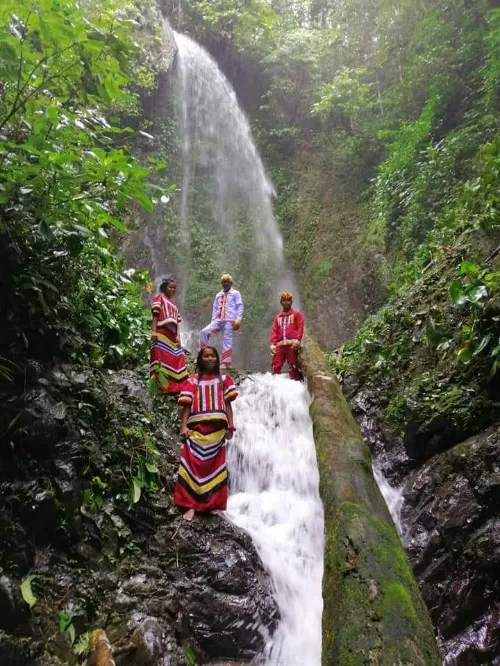
Speaking of bringing back the sacred, the Higaonon Bloom chapter is doing just that. Seventy elders, youth, and leaders joined Tribes and Natures Defenders for Kapamulakaw - a yearly ceremony of chanting, river crossing, and clean-up to apologize to the river custodians and protect the rainforest and fresh water they worship as their place of connection with the creator.
Kapamulakaw: Sacred Ceremony To Heal The Rivers
For settlers living far from your ancestral waters, here is one ritual idea for you. I've always wanted to organize a Bloom event where people caravan to a local body of water - a river, a lake, a large pond - before sunset to connect with each other. Then sit together in silence under the moon, listening to the body of water. What might she whisper to you?
Water. Go to her, listen to her. Water really is life.
These are actions any community can do. It just takes one person willing to organize it. That is the scale at which watersheds change.
The native seeds swap is also a doorway into our next issue, Forests & Soil, all about growing food and tending land in ways that restore life around you and within you.