Owning Our Own Regenerative Supply Chains
Announcing BEU x Bloom coffee partnership - available now in the US and EU
✔️ This action has been verified.
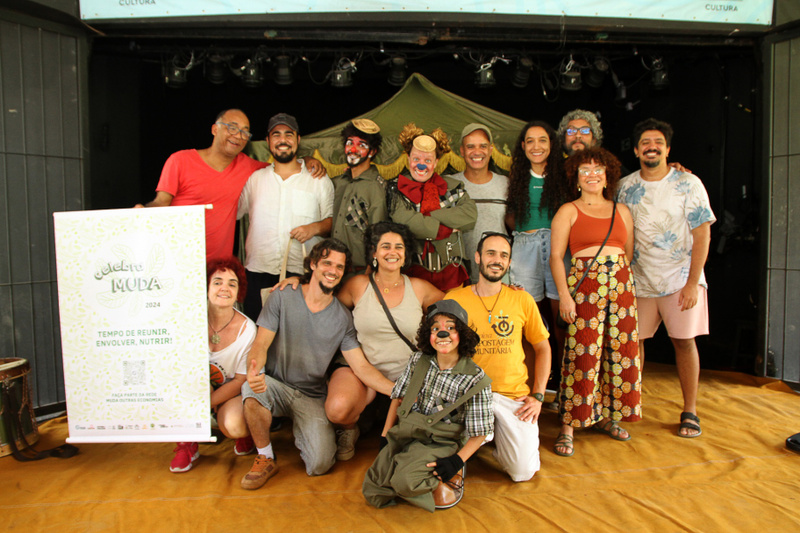
Every year at Muda we celebrate our existence by gathering partners from our network and combining efforts to bring more happiness, culture, regenerative practices, and love into our world. We call the festival Celebra Muda and this year we celebrated our 5th Anniversary.
Back in Rio, our celebrations kept in full force. On December 10th we organized an online panel about Social Currencies and Regenerative Finance with Karla Córdoba (Cambiatus and CoFi Blocks), Luiz Haddad (Muda), Mila Rioja (Instituto Plexos), and Marcelo Silva (Celatam, ReFi Spring).
From December 12th to 15th, we focused again on in-person events and mobilized many of our partners in different cultural and intellectual activities.
On the 12th, our celebrations started at Penha Favela as we were welcomed by our partners from the educational NGO CEM for a day of joy and activism. The day started with a circus and theatre performance for the children, presented by our partners from Grupo Pedras, Cia Boca do Lixo, and clown Bolacha.
Afterwards, we went to the NGO headquarters for a women’s circle where we talked about alternative economies and celebrated our partnership with different women-led projects. We were pleased to have Iyá Wanda Araujo (Candomblé house Yle Asé Egi Omim), Ana Santos (CEM), Carol Santos (Educar+), and Mariana (Instituto Arandu) exchanging their experiences as active members of Muda’s network and expressing the importance of an alternative monetary system as a mean of political resistance. And we onboarded some kids to Muda's platform.
Also, our partners from Terra Orgânica held a workshop for CEM kids and educators regarding composting practices.
At night, it was time to relax and have fun at an impressive Cabaret Party we organized to praise Clowning Day. To amuse us, we brought together the following 12 artists for a night of black comedy and lots of music: Cia Urbana de Dança, Claudio Carneiro, Jujuliete, Fabio Freitas, Franco Fonseca, Hugo Germano, João Carlos Artigos, Marta Paiva, Shirley Brito, Assuna Party with DJ Ivam Cruz and DJ B.A + Proceder Band from Dandara School CPX.
The next day, on December 13th, we held a discussion circle to celebrate the launch of the book “History of Cannabis in Comics: Culture, Health and Society”. The book takes the reader on an engaging journey through the pages of the history of the Cannabis plant, which has influenced civilizations, cultures, and social movements over millennia. With vibrant illustrations and careful historical research, the narrative reveals how Cannabis was used in spiritual healing practices and for treating illnesses, until it faced periods of criminalization and prejudice over time, shaping social and scientific issues that still resonate today. The panel was hosted by Derick Rezende, our partner from SouCannabis and Instituto Arandu, and had Rhariane Maia, Monique Prado, Ladislau Porto, and Gregório Ventura as invited speakers.
Later the same day, we had the theater performance of Solo da Cana with Izabel de Barros Stewart. Solo da Cana is a stage work that deals with the cultivation of affection in relationships between beings. To this end, it fictionalizes a vegetal voice, in an attempt to broaden the listening beyond humanity: sugarcane, an icon of agro-pop monoculture, comes to the public to bring a perspective of resistance to colonialism and the erasure of differences. Solo da Cana deals with a battle between the expansion of the agricultural frontier and the atrophy of the sensitive, between surplus and hunger, in the fight for a land that recovers and regenerates the whole.
To close the night, we danced Forró at Kiko's Forró Party, which invited a group of top-notch guests: Marcelo Mimoso, O Xaxadinho, Negadeza, Amora Pêra, Cláudio Jorge, Carol Panesi, PC Castilho, Pro ARTE Wind Orchestra, Mônica Besser, Maju Nunes and Déborah Cecília. And during the breaks, DJ Ivam Cruz.
The next day, on December 14th, it was time to visit our partners from Educar+ at the Chapadão favelas to bring them joy and culture with the performance of ‘Dando Ouvidos’, a solo show from artist Angélica Gomes. This children’s show aims to reinforce the sense of circularity and continuity of the cycle of life. It listens to what children have to say about seeds, birth, life, and death. It is a Toy-Show, an invitation for children to participate in a theatrical event, connecting with the actress and with each other, through a narrative that is constructed with interactive games. The actress brings to the stage the technique of clowning and her vast experience as an educator, breaking down the boundaries between stage space and audience.
At night, we had the adult theater performance ‘Cão Chupando Manga’ (Dog Sucking Mango). It is a show that combines theater, circus, dance, and visual arts, centered on clowning and buffoonery. In it, performer Fábio Freitas dives into sleepless nights, tormented by the incessant barking of a purebred dog. In this intense duality between lost sleep and the fight for dignity, he metamorphoses into a caramel-colored mongrel, a symbol of Brazilian resistance, in a battle that transcends the canine world. This 'dog show' reveals itself as a powerful metaphor that invites the audience to reflect on the complexities of human relationships, the challenges of life in society, and the noisy contemporary days.
Last but not least, on December 15th, our partners from Cia Boca de Lixo presented their children’s play ‘Inventando Moda’ (Inventing Fashion) which takes the audience on a vibrant and exciting journey through Brazil's cultural traditions, narrated by three clowns: Siriema, Mutamba and Maré. As a result of 17 years of research into popular culture, the play explores with lightness and humor the diversity of artistic and cultural expressions in Brazil, celebrating the 17th anniversary of the Boca do Lixo company. Amidst laughter and enchantment, the clowns reveal the beauties and challenges of a life dedicated to art and tradition, connecting the audience with the living essence of Brazilian culture.
IMPACTS