REGENERATIVE ACTION

Letting the Garden Rest: Closing the Season Through Compost
...
Eugene, Oregon
dates
October 2, 2025 to January 1, 2026
participants
2
objective
Closing the loops by making compost material for next season's garden using last season's plants
Project

Maybloom

Maybloom is a nascent space, collective and venture that is interested in exploring regenerative solutions towards sustainability. We are currently a 2 person (and 1 dog) team exploring the intersection of regeneration, permaculture, technology, crypto, gardening, and sustainability.

As fall comes to a close, the work at Maybloom continues to follow the rhythm of the season. After months of tending, harvesting, and clearing, this phase is about closing loops—cleaning the vegetable garden, gathering what the land offers at the end of the season, and returning those materials to the soil through compost.

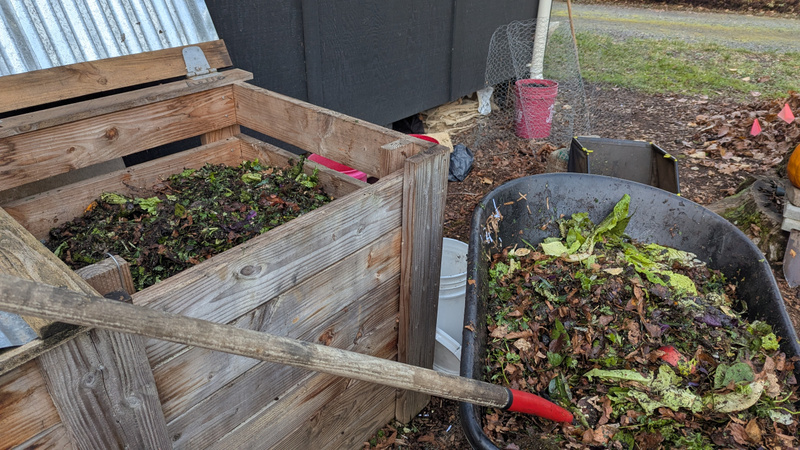
With the growing season finished, we cleared out spent vegetable plants and garden beds. Rather than seeing this as removal, we treat it as a transfer. Stems and leaves from the garden are folded directly into our compost system, carrying the nutrients of this season forward into the next one. The garden doesn’t empty—it transforms.

Across the property, fallen leaves and grass clippings became key inputs. Community inputs have also continued to strengthen the system. We’ve been receiving increased donations from local businesses in the form of food scraps and used coffee grounds. These materials add nitrogen, help maintain compost activity as temperatures drop, and keep organic waste out of landfills by cycling it back into living soil. Together, they help create compost piles that stay aerated and biologically active. We track the progress of this process by measuring pile temperature with a compost thermometer, using heat as a signal to understand microbial activity and guide adjustments to the mix.

We’re also incorporating biochar produced on-site into the compost. After activating the biochar with urine to charge it with nutrients, we mix it into the piles so it can absorb moisture, microbial life, and minerals before eventually returning to the soil. This step helps ensure the biochar becomes an active part of the ecosystem rather than an inert amendment.

Composting at Maybloom remains a hands-on, observational practice. Every few days, we return to turn the piles, check moisture, and monitor temperature. Maintaining balance between greens, browns, air, and water is an ongoing process—one that responds to weather, inputs, and seasonal change rather than fixed formulas.

This end-of-fall work is about continuity. By cycling garden material, leaves, grass, food scraps, coffee grounds, and biochar back into the compost, we’re keeping nutrients on-site and in motion. While the garden rests above ground, soil-building continues below, quietly preparing the conditions for the seasons ahead.

IMPACTS

  • - 12 garden beds cleaned, prepared for winter, and materials processed into compost
  • - 400 pounds of food scraps from local businesses diverted from the landfill
  • - ~350 cubic feet of compost material ready for next season

More Adventures

  • Swipe to see more