REGENERATIVE ACTION

Fall Work at Maybloom: Clearing, Pruning, and Preparing for What’s Next
...
Eugene, Oregon
dates
October 1 to December 31, 2025
participants
2
objective
We are preparing the land for the seasons ahead
Project

Maybloom

Maybloom is a nascent space, collective and venture that is interested in exploring regenerative solutions towards sustainability. We are currently a 2 person (and 1 dog) team exploring the intersection of regeneration, permaculture, technology, crypto, gardening, and sustainability.

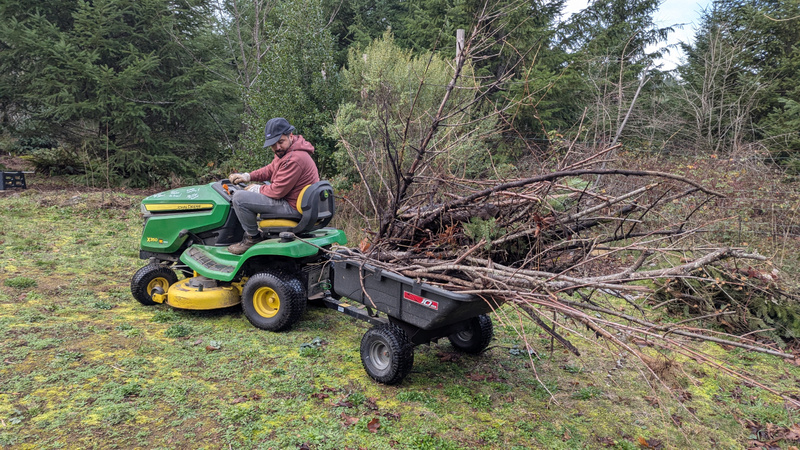
As the seasons shift, we’ve been spending time at Maybloom doing some important fall preparation work: pruning trees, pulling blackberries, and getting a biochar mound ready for a future burn. This work is part of a longer vision of tending the land in ways that increase safety, resilience, and ecological health over time—especially in a landscape where invasive species and wildfire risk are real and growing concerns.

One of the biggest efforts lately has been removing invasive blackberry from different areas of the land. While it’s slow, physical work, it’s also deeply satisfying. Pulling blackberries helps us reclaim space that had become inaccessible, opens up light and movement through the property, and makes the land feel more cared for and welcoming. Just as importantly, it reduces dense fuel loads—an essential step in fire preparedness as we look ahead to future summers. What might look like simple clearing is actually about prevention, stewardship, and reducing risk before it becomes an emergency.

Alongside that, we’ve been pruning trees with an eye toward long-term health and balance. Careful pruning improves airflow, reduces stress on branches, and supports stronger, more resilient growth. This process continues to remind us that caring for trees is less about control and more about relationship—learning when to intervene lightly and when to let the system do its work. The material generated through pruning becomes part of the larger cycle rather than waste.

That ties into the third piece of the work: preparing a biochar mound. Woody debris from pruning and clearing has been intentionally gathered and organized, setting the stage for a future biochar burn when conditions are safe. Biochar is one way we try to close loops at Maybloom—turning excess biomass into a stable form of carbon that can be returned to the soil. It’s a long-term investment in soil fertility, water retention, and carbon storage, and a practice that others can adapt in their own gardens or land projects.

All of this fall work is less about immediate results and more about setting conditions for the future: a safer landscape, healthier soils, and a space that continues to evolve toward resilience and abundance. It has reinforced for us how interconnected these systems are—fire prevention, soil health, invasive species management, and human effort all influence one another. The work is slow, sometimes messy, and often invisible in the short term, but it feels deeply aligned with the kind of care we want to practice here.

Looking ahead, we’ll continue maintaining cleared areas, monitoring regrowth, and preparing for the biochar burn when timing and weather allow. We’re also continuing to learn, refine our methods, and share what’s working. If you’re part of the Bloom Network, support can look like sharing knowledge around fire-wise land care, invasive species removal, or biochar practices—or simply carrying these approaches into your own spaces and communities. More soon as these systems continue to take shape.

IMPACTS

  • - 12 distinct areas of invasive blackberry cleared by hand
  • - ~5,000 sq ft of land reclaimed and made accessible
  • - numerous (10~20) invasive cherry trees removed
  • - ~15 trees selectively pruned for health, airflow, and safety
  • - 1 biochar mound prepared using reclaimed woody biomass

More Adventures

  • Swipe to see more